
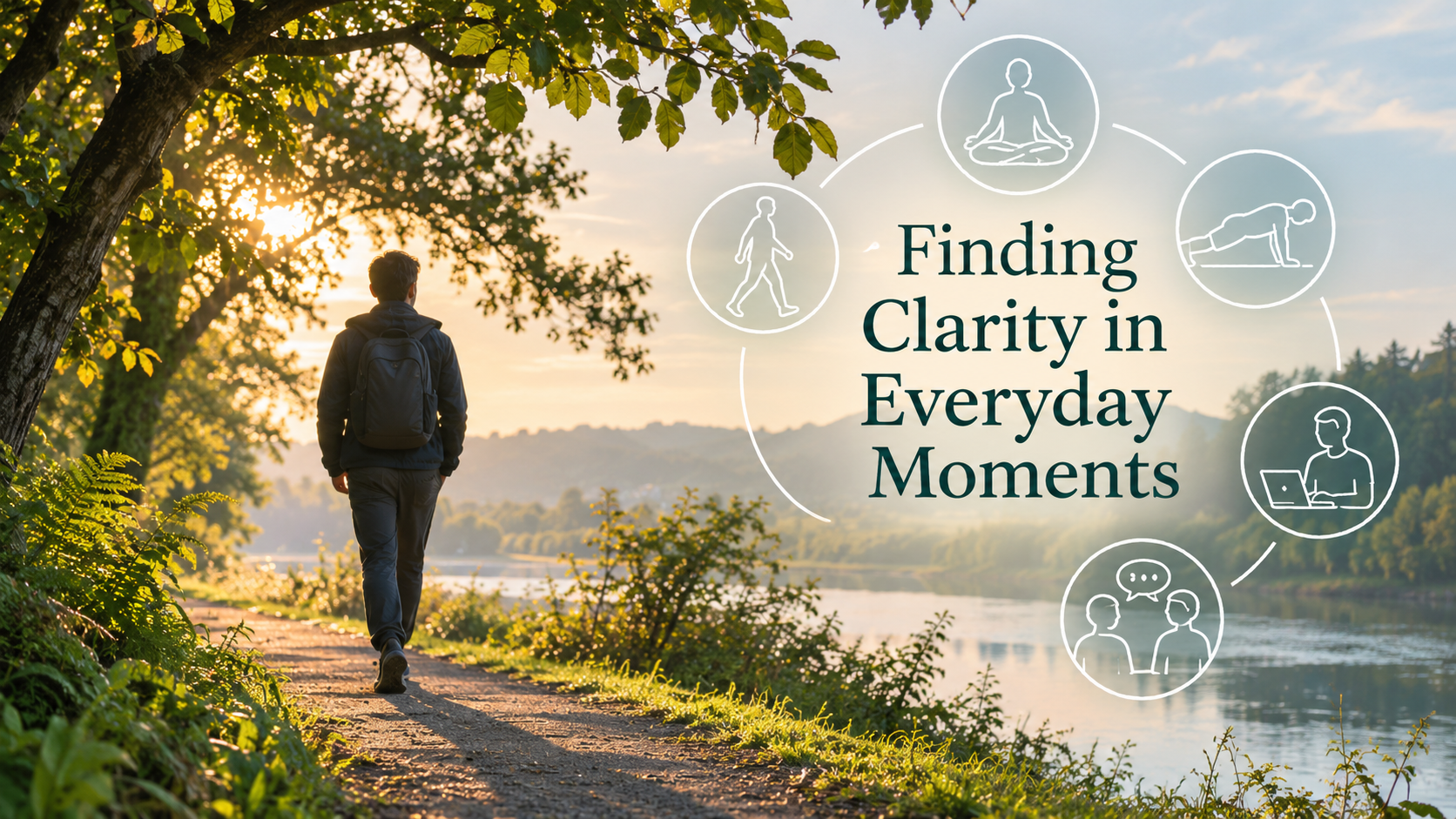
Finding Clarity in Everyday Moments
We often associate clarity with meditation, reflection, reading and moments of insight. Yet sometimes it emerges naturally when we’re engaged in simple, ordinary activities, such as walking home, exercising or spending time outdoors.
I think it has a lot to do with where we place our attention.
Where your attention rests
Someone asked me recently whether thoughts disappear during meditation.
In my experience, thoughts can continue arising, but our relationship with them changes.
When attention settles into the body, the breath, or the sensations of walking, thoughts can gradually move into the background. Rather than becoming absorbed in each thought, we can observe them while remaining connected with our immediate experience.
This doesn’t necessarily require a long meditation session. Even a few breaths or steps can help us recognise where our attention has been resting and gently redirect it.
Everyday activities as practices of awareness
This extends well beyond meditation and Qigong. Even familiar daily activities can offer small opportunities to cultivate awareness.
During a push-up, for example, I can bring attention to my balance, breathing, weight distribution and how different parts of the body coordinate to produce movement.
When working on a project, I can notice when I’m approaching something with unnecessary tension. There might be moments where focused effort feels appropriate, and others where slowing down creates clarity about how to move forward.
At times, stepping away, practicing some grounding Qigong for a few minutes, or simply resting attention and observing thoughts might help me return with renewed energy and clarity.
During a conversation, I can pay attention to the other person, my own responses and the direction of the exchange, following the journey rather than focusing on a particular outcome.
Often, when we change the quality and direction of our attention, we bring a different perspective to an activity or interaction.
This connects with what I appreciate about Qigong. Through relatively simple movements, we can explore how attention, intention, breathing and physical sensations interact. With practice, this awareness can gradually extend into other areas of life.
Exploring awareness
Here’s a simple practice you can explore, whether you’re at home, on an ordinary walk, or navigating a complex situation or relationship. Give it two minutes:
- Notice how your body and feet contact the ground, including subtle shifts in weight and adjustments in posture.
- Bring attention to your breathing, its natural rhythm and the movements involved, perhaps the expansion of your belly and ribs.
- Observe your surroundings, such as the light, sounds or the air against your skin.
Thoughts may continue arising throughout. Question whether you need to suppress them right now, or whether you can safely rest in awareness, observing thoughts and creating space around them.
This relationship with the mind can sometimes feel uncomfortable, particularly as thoughts and emotions surface. We can explore how to respond to them, giving ourselves space to gradually process what arises.
A walk or Qigong practice can provide an opportunity to settle, reconnect with the body and gradually work through some of what has been occupying the mind.
You might also explore mindfulness during other activities, noticing how your experience changes depending on where your attention rests.
Through simple moments of awareness, everyday activities can become opportunities to cultivate presence, connection and clarity.






Leave a Reply